
My trip to Japan was, of course, everything I wanted and more. I had it jam packed with learning and curriculum connections and amazing cultural experiences, and I was lucky enough to experience almost everything I had planned.
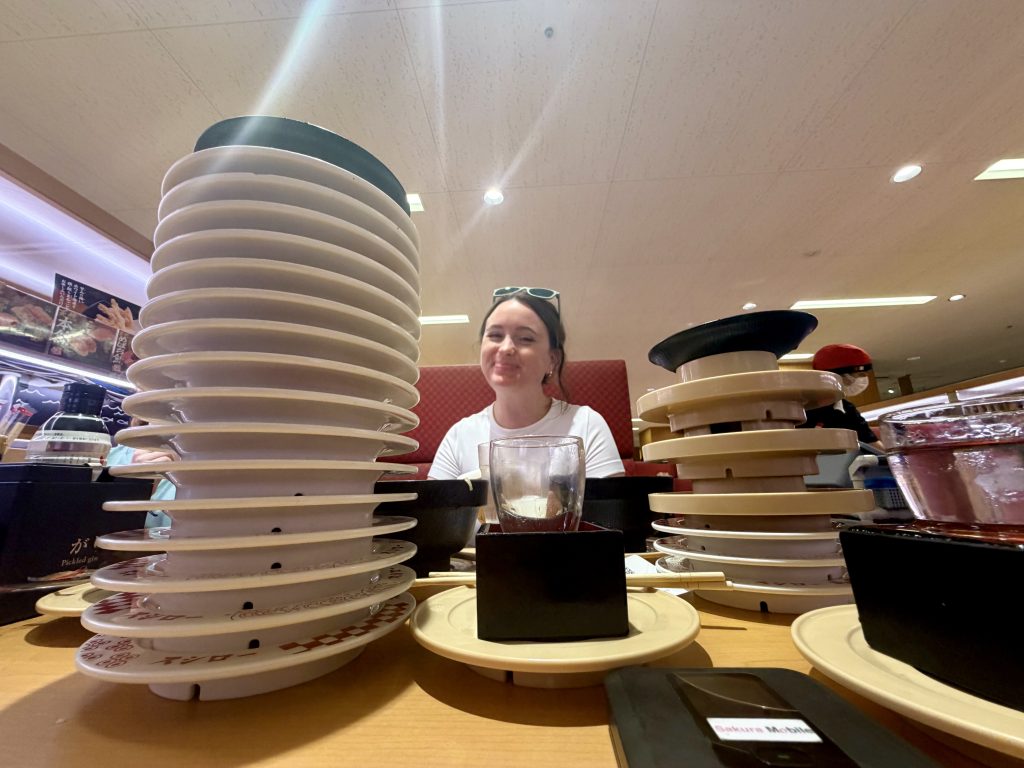
We started off by landing in Tokyo and stumbling through the train system to get to what would be our home base for several days in Asakusa. What we couldn’t see from street level was a surprise upon opening our hotel room curtains: the Senso-ji Temple Pagoda that is as tall as an 18-story building less than a block from us. Knowing we needed to stay awake until bedtime in Tokyo to adjust to the time change, we set out to explore and find dinner. The temple grounds at night were calm and lit up, a little bit of tranquility tucked away in the middle of our bustling neighborhood. The next day was full of firsts: first Don Quijote shopping experience, first konbini store meals, first arcade wins, first conveyor belt delivered meal, and first chat with a friendly Japanese citizen. Right after we walked across the Shibuya crossing (the Tokyo equivalent to Times Square), a lovely elderly Japanese man thanked us for coming to learn about his country and asked us our ages, assuring us all that we were very young. We found mesmerizing 3D billboards, Godzilla peaking above the skyscrapers, amazing views of the city, and an amazing stationary shop. I purchased postcards and origami cranes that I would fold myself to welcome my new class.
The next day we had a kintsugi workshop, which had to replace my original ukiyo-e experience since that shop had shut down. It was a stroke of luck, however, because I adored the lesson on the tenets of kintsugi: we embrace the flaws of the pottery as symbols of strength, resilience, and the valuable history of the piece. An entire SEL lesson unfolded in my head as we worked. We then took a river cruise to Toyosu to visit Team Labs, an interactive coding masterpiece. Team Labs is hard to describe. Every room you enter along the path of this huge indoor space has been prepared and coded to respond to you in some unique way, from light and color, to movement and music. In one room you walk through hanging orchids that seem to sing and move magically up and down to avoid you as you move through the space. In another you color a butterfly or gecko and feed it into a machine that spits it out as a projection of your animal moving through the space. Everything felt magical!
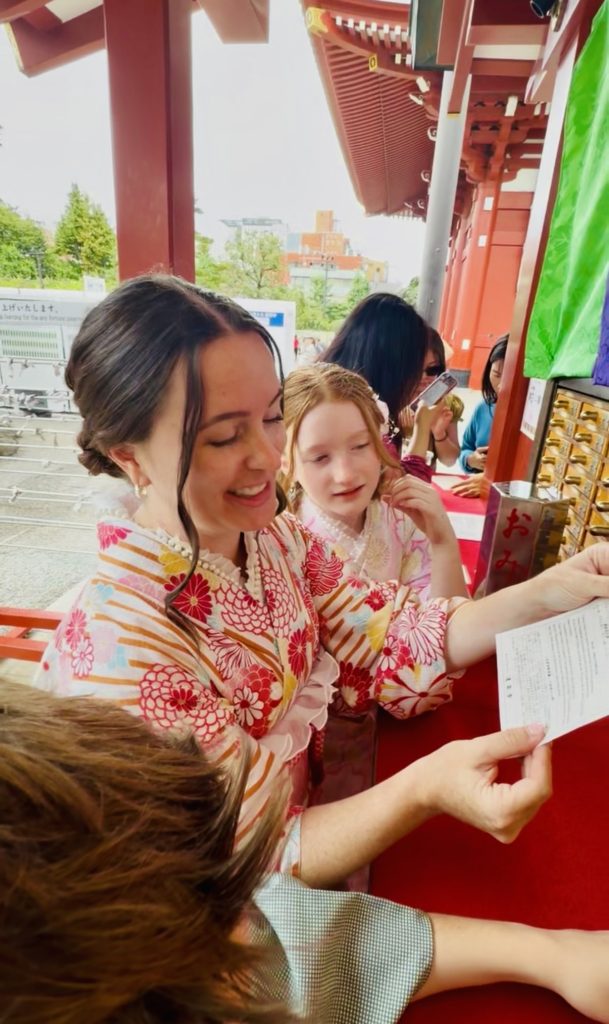
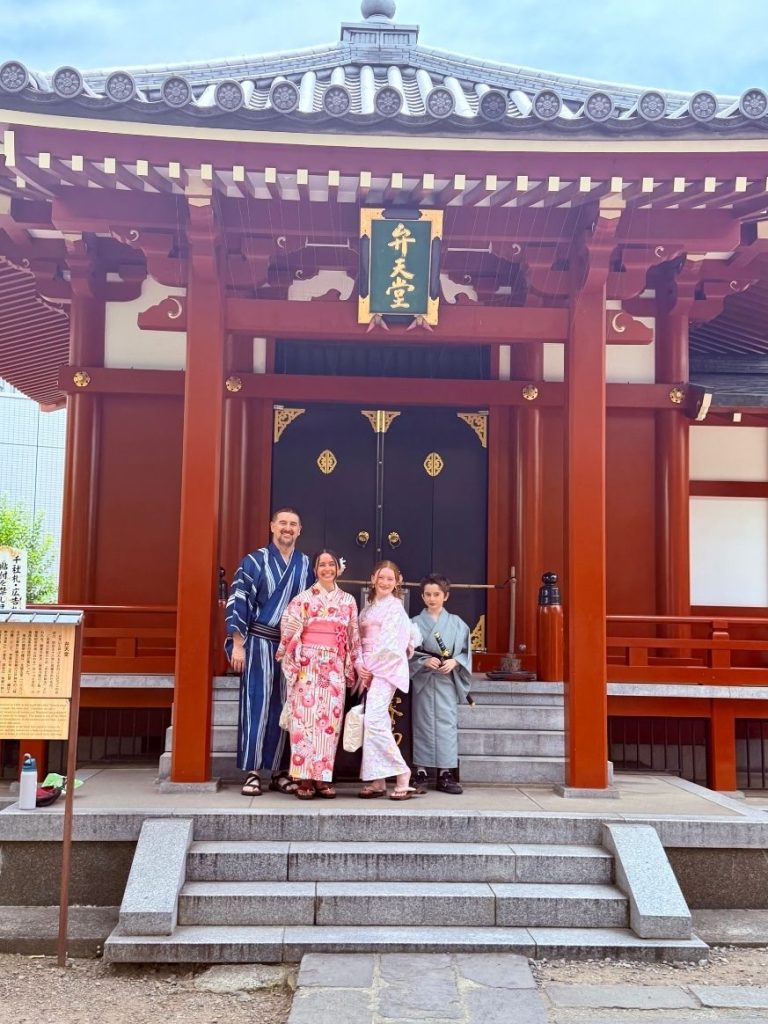
The following day was one of my favorites. In the morning we went to an appointment to be dressed in traditional yukata, or summer kimono. Two sweet and tiny Japanese women styled our hair and dressed us in countless layers that just kept coming. I was unprepared for a long thick band of cloth that just kept coming to wrap around my waist like a corset. Japanese Baaba (granny) didn’t speak much English, but knew how to ask if she could go tighter. I politely deferred to her, assuring her I was good for it, until I realized that she’d keep tightening until I said to stop! I tried to use my modest Japanese to explain, but when I reached for a word I didn’t know, my brain filled it in with the Spanish word, leading to all around confusion! And more tightening! We finally figured it out, but when we ventured out of there all dolled up, I could barely walk! I wasn’t about to let that stop me though; we all walked clickety-clack in our traditional geta sandals through the traditional shops lining the pedestrian walkway back to Senso-ji Temple. I was relieved to see that there were many Westerners and Japanese alike using the lovely day to wear Yukata. Many Japanese told us we were ‘kawaii’, cute, as we passed, and stared with wide eyes at my daughter’s red hair! At the temple, some lovely Australians took photos of us and asked where on earth they could come by such outfits. After giving them the info, we headed over to the fortune stations of the temple, just like a character in one of our 2nd grade books, whose job, by the way, was a geta sandal maker. I had read the rules to make sure I was being culturally sensitive, and so I knew I needed to pay 100 yen for each fortune and think of the person I was pulling it for in order for it to be their fortune and not mine. We pulled so many fortunes! We read them aloud since many were ‘bad’ fortunes that we had to tie to metal stands to be burned that evening! This was a pivotal cultural experience for me! After a few hours, we toddled back to return our outfits. I spent the afternoon working on learning Japanese with a guide after Japanese lessons at a language school fell through. Again, I noticed my reliance on Spanish to fill any gaps! Apparently that’s my ‘go-to’ second language! It was good to be in the shoes of a learner though! Unfortunately, I had eaten something that didn’t agree with me, and I started to feel ill by evening. I was forced to take the next day to slow down and rest at the hotel, curling up with a book by a window overlooking a rainy day in the city.
The following day I allowed myself a restful morning, knowing I’d cause myself more trouble if I pushed myself too much. Still, I was ready to venture out in the afternoon, and my changed plans had me searching for something new to do! This was how I found Ninja Training, which was a fun win! We learned to wield a katana, throw ninja stars, and blow darts.
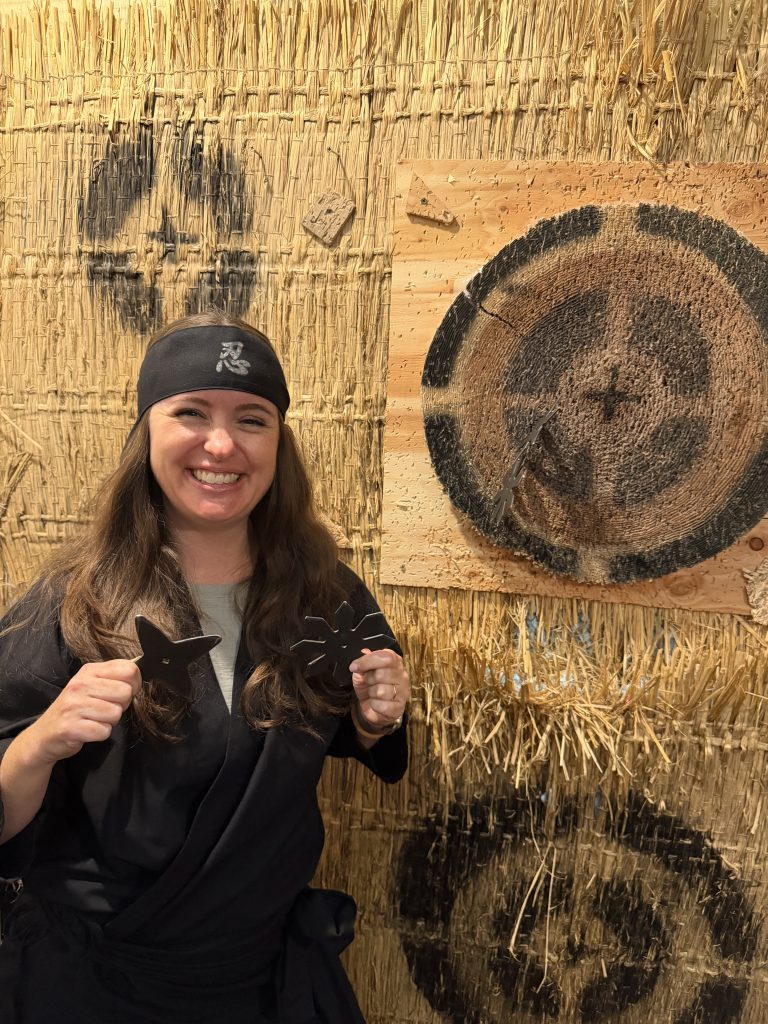
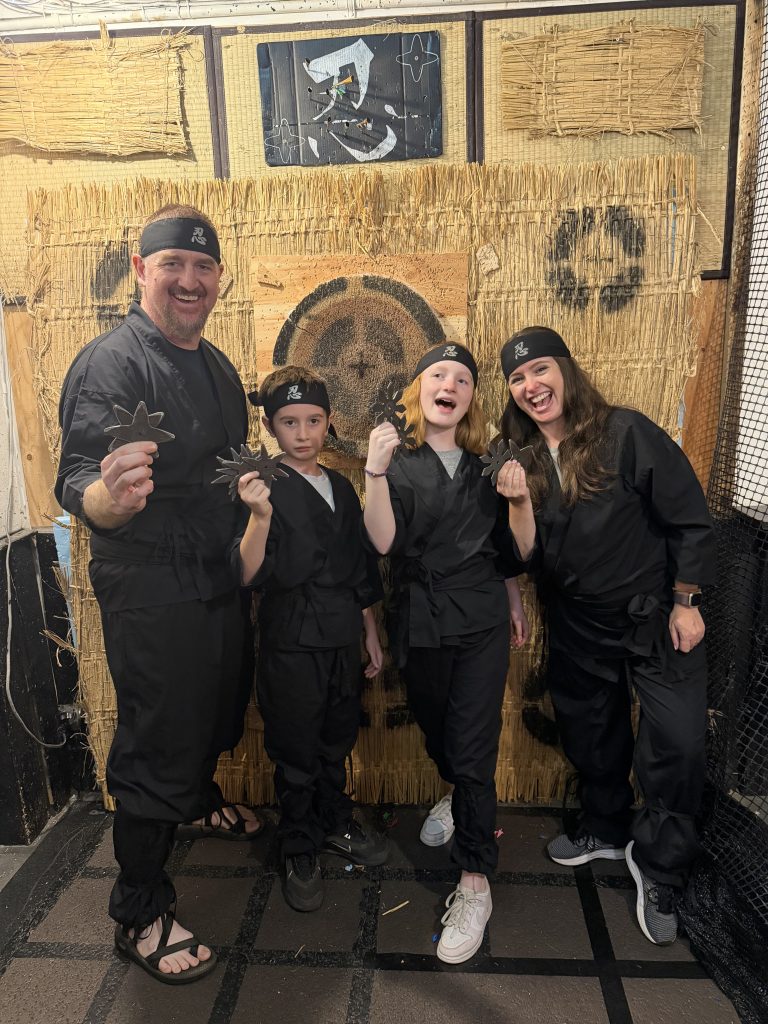
The next couple of days I felt better and we learned to survive earthquakes, floods, typhoons, and fires, made chopsticks, and took the amazingly fast bullet train down to Hiroshima. Disappointed that ‘real’ mountain climbers had beat us to the reservations to ascend Fuji, we consoled ourselves by getting the tiniest peak at it from the shinkansen train. The train itself felt like being on a first class only airplane on which no babies or noise were allowed.
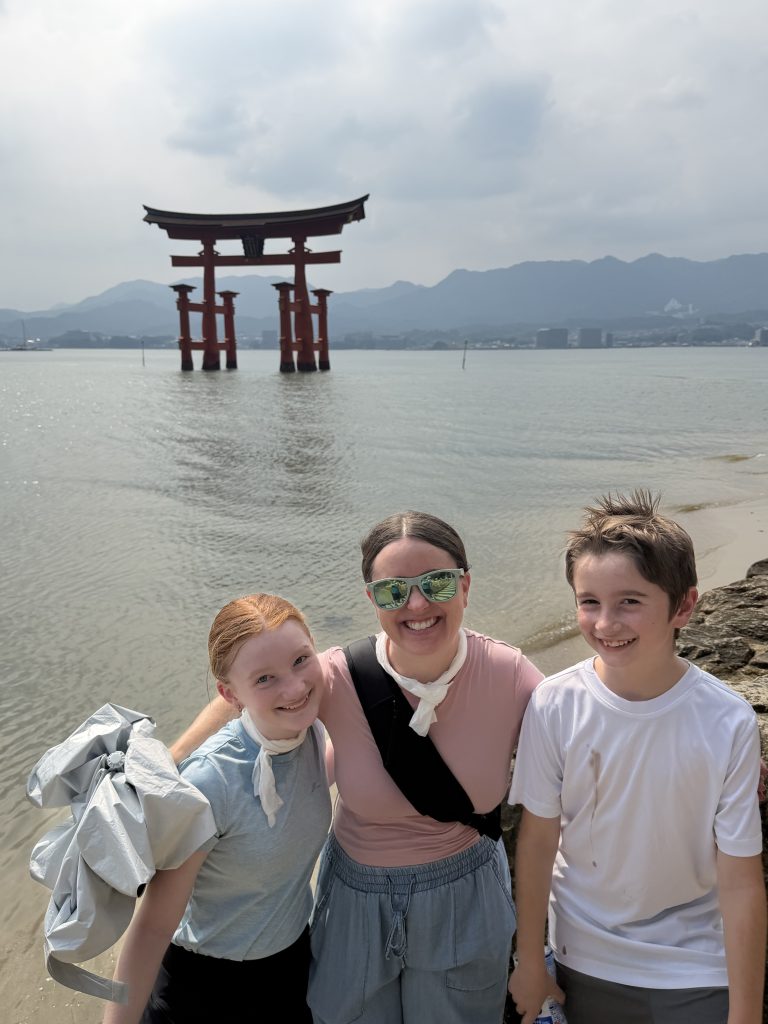
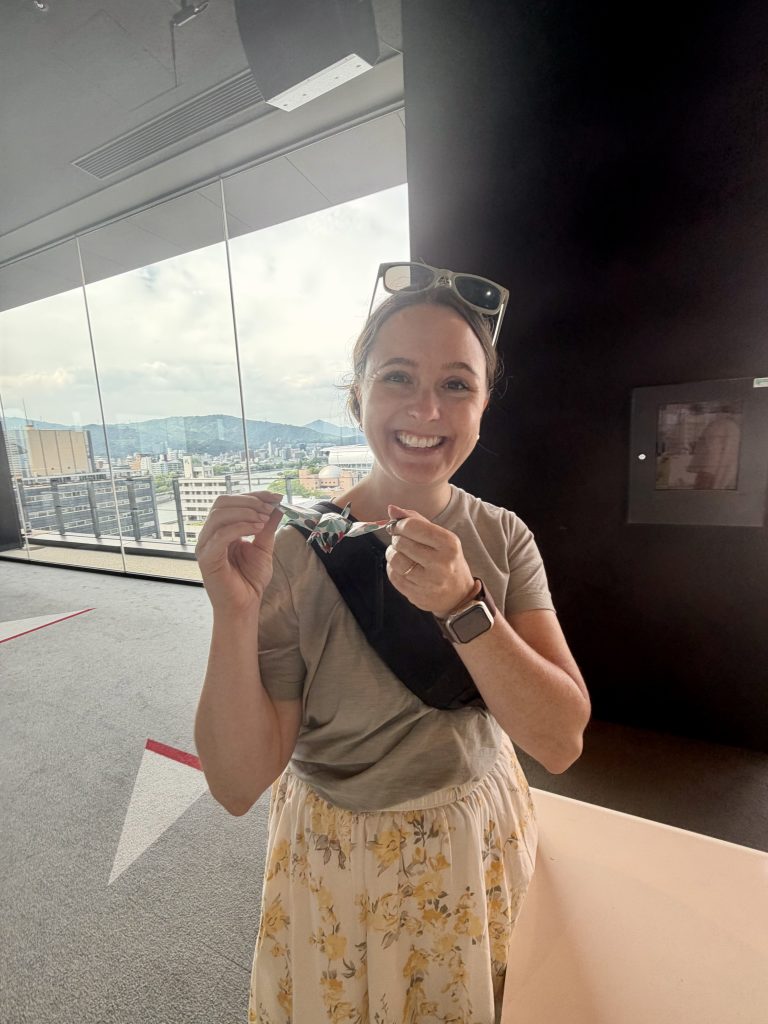
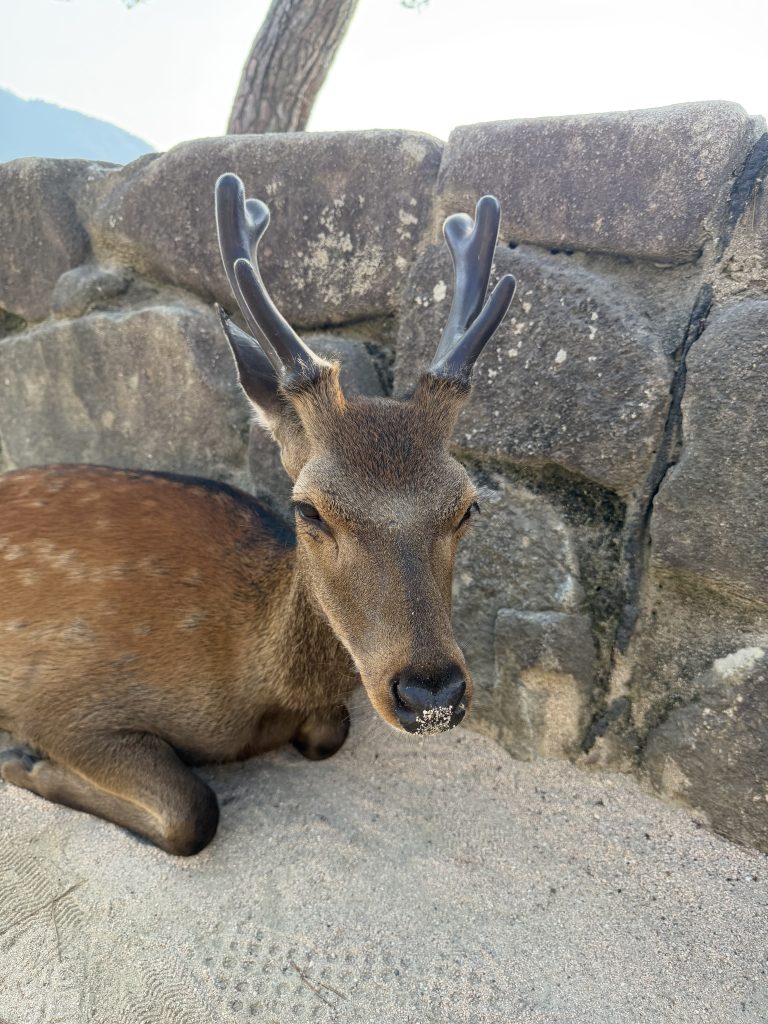
Hiroshima was my favorite place, which surprised me. It didn’t have to try, it just was a place rooted in such amazing history, and such an amazing path forward that they’d chosen, that it stood out to me. We saw the Genbaku Dome, eternal flame, and memorial museum, ate the local specialty of Okinomiyaki, learned the history, heard the harrowing stories, and learned to make peace cranes and make our own wishes for peace. Every bit of this place felt special. From here we took a ferry to Miyajima Island, where the deer who bowed for food from humans were fiestier, and nippier, than expected! The giant floating torii gate is simply not done justice by the photos. We hiked up the mountain and took the ropeway up to the top, where we could only take in the views momentarily before coming back down. The torii gate was now reachable by foot since the tide had gone out, and I was relieved that we’d captured its beauty from the shore earlier when it wasn’t surrounded by people.
Next was a few days in Osaka, where we rode the world’s only oval shaped ferris wheel high above the city (frankly it was terrifying), took in the beauty and rich history of Osaka Castle, and visited an absolutely singular aquarium. I’ve never experienced anything like it. After an escalator ride up several floors, visitors wind their way back down through the floors by spiraling around the massive cylindrical central tank. The outer tanks changed as we went. The center tank was the stand out and chock-full of different types of sharks, fish, two massive whale sharks, and the quirkiest sun fish that wanted to be our buddy. The outer tanks included dolphins, seals, penguins, spider crabs, and jellyfish. It was an indescribable show of the ocean’s biodiversity and wonder.
Also in Osaka, we got to attend a sumo experience that included a lesson on their history, ties to religion, and training. Two real retired sumo wrestlers showed us the ropes, eventually asking for volunteers. My wrestler husband was happy to represent our family when the rest of us balked. We watched as they put him through some training and finally pitted him against Ryu, an enormous man who had just thrown a Ukrainian man out of the ring and almost directly at me. I had my concerns. But he held his own and almost bested him…instead ending up with more than 260 pounds of sumo wrestler landing on him when he rolled him! Everyone was very concerned about him, but he brushed it off and they bowed respectfully to each other. Unlike the Ukrainian, who insisted on an unprecedented round two and was thrown out again like a rag doll!
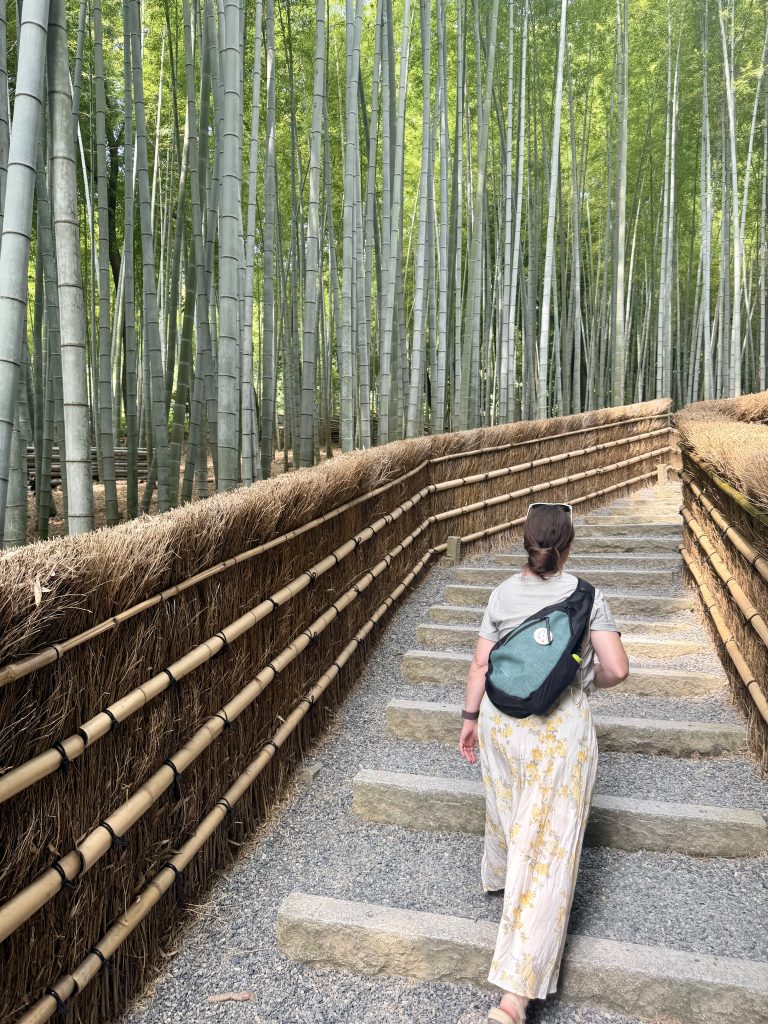
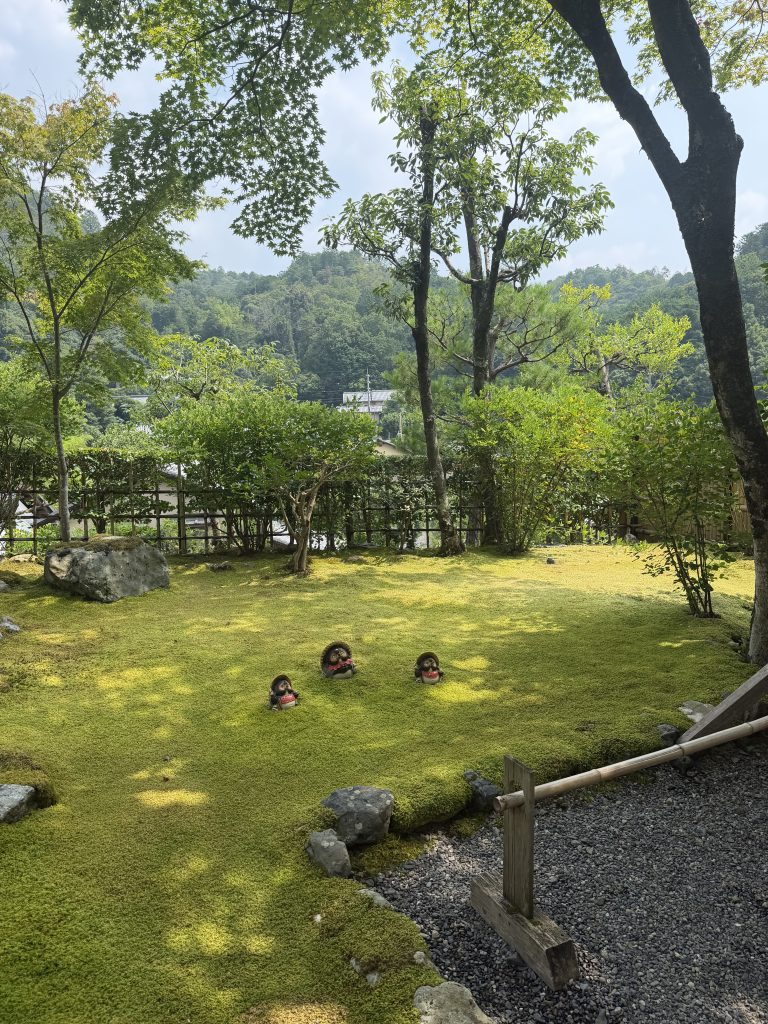
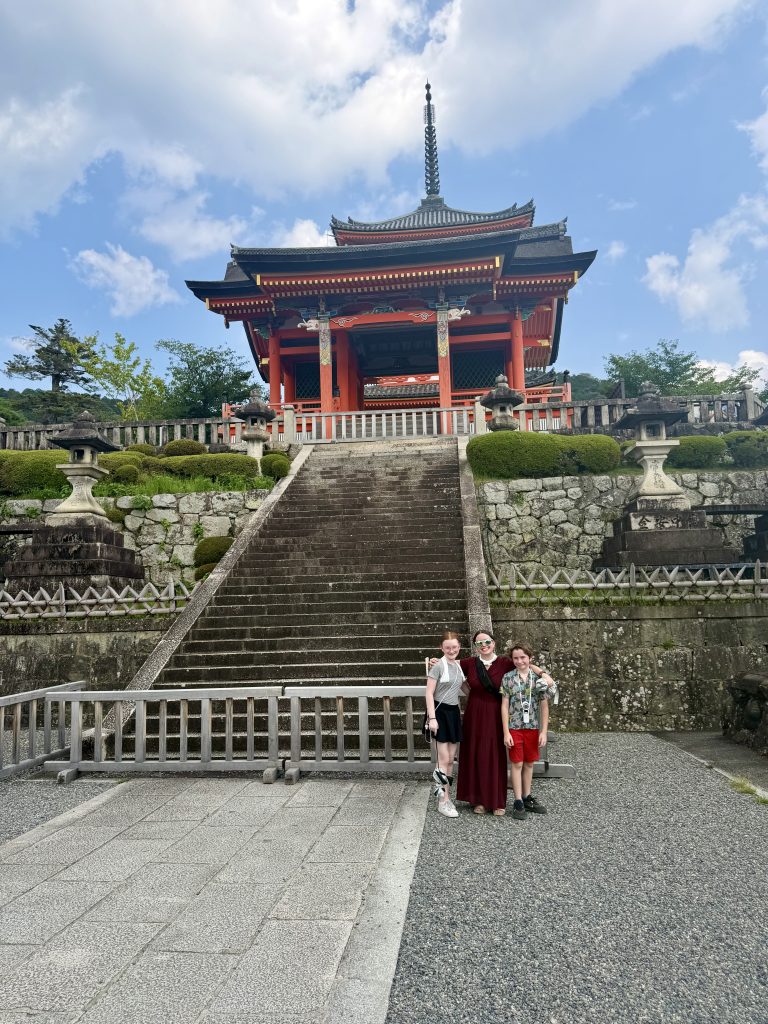
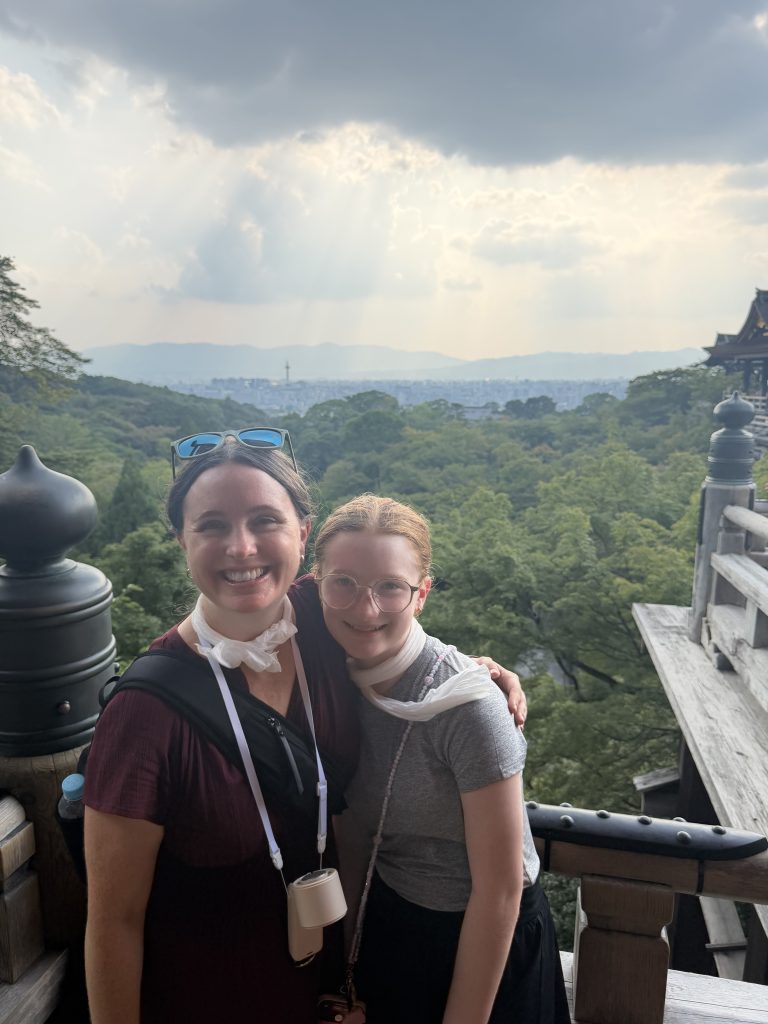
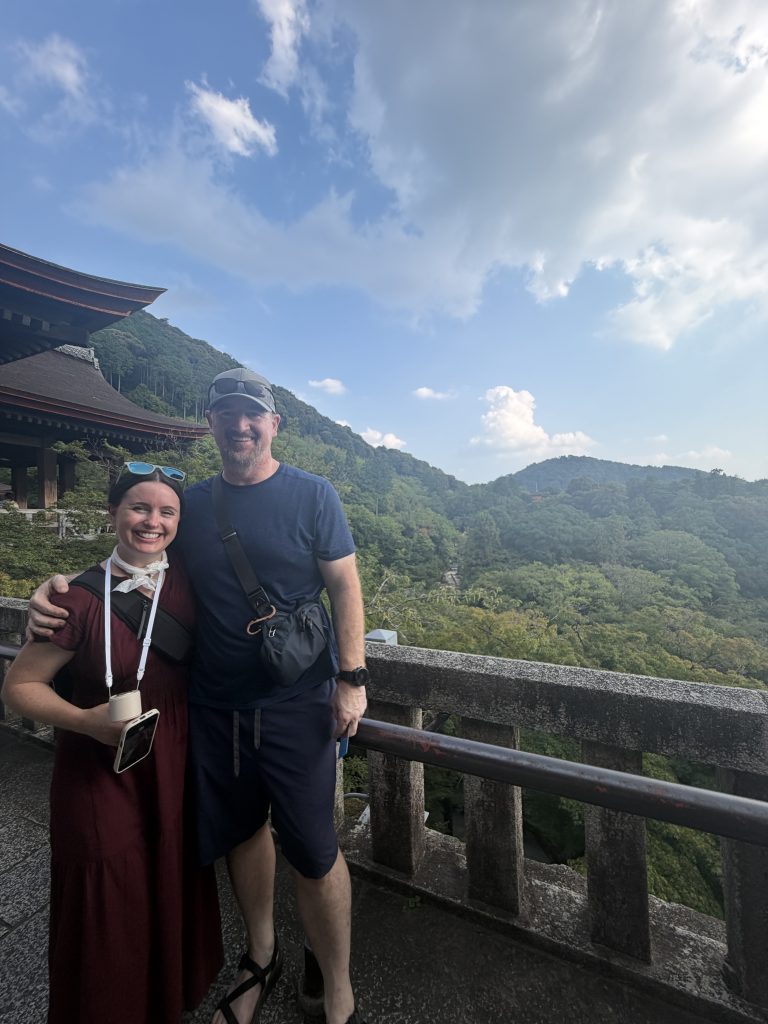
Our final stop was the serene and naturally beautiful Kyoto. The Kiyomizu-dera temple offered heart stopping sunset views of the city below. The bamboo grave at Adashino Nenbutsuji Temple was especially stunning, giving the nature lover in me that feeling you only get from soaking in how serendipitous some of the beauty on earth is considering how many great things had to fall in place for certain things to exist. It was here that I learned that the Japanese, of course, have a word for this: Yūgen, which is the profound and mysterious sense of the beauty of the universe and awareness of the emotional response it elicits that is completely ineffable. It just is. I’m lucky to have felt Yūgen many times on this planet, and now to have found a word for it. Adding to the allure of this place was the small shrine filled with children’s toys, and a baby statue that someone had forced a onesie onto. Confused, I used my translator app to translate the plaques. It was a shrine for all the children who were lost too young, which holds a special place in my heart. I only wished I’d had something to offer.
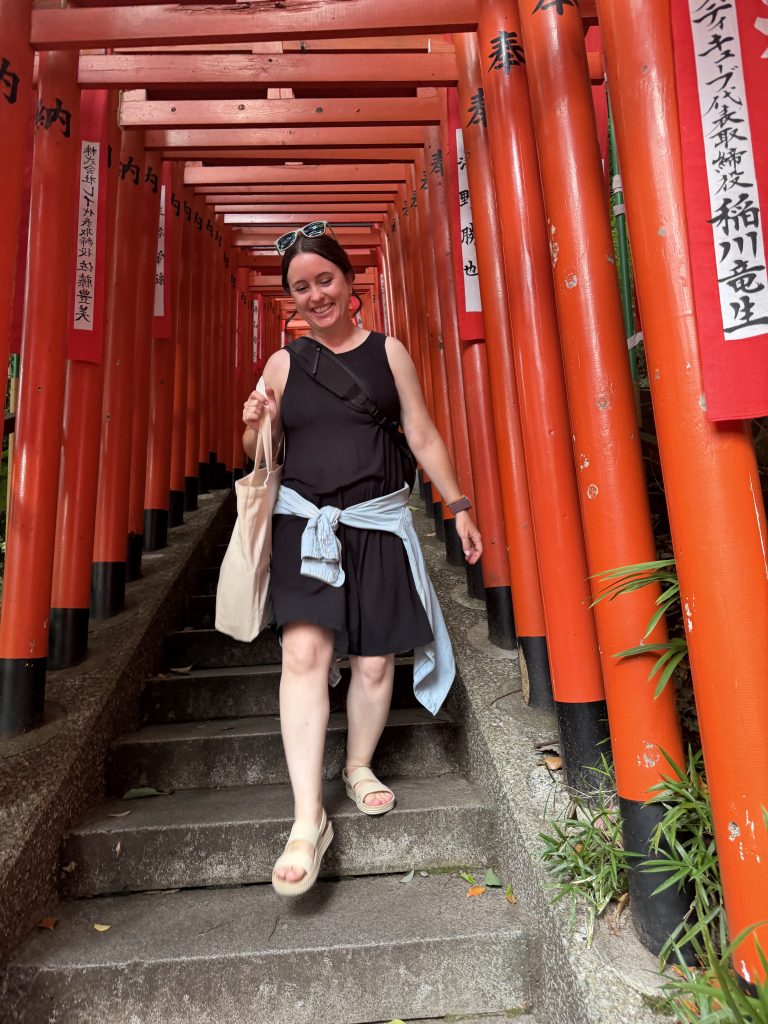
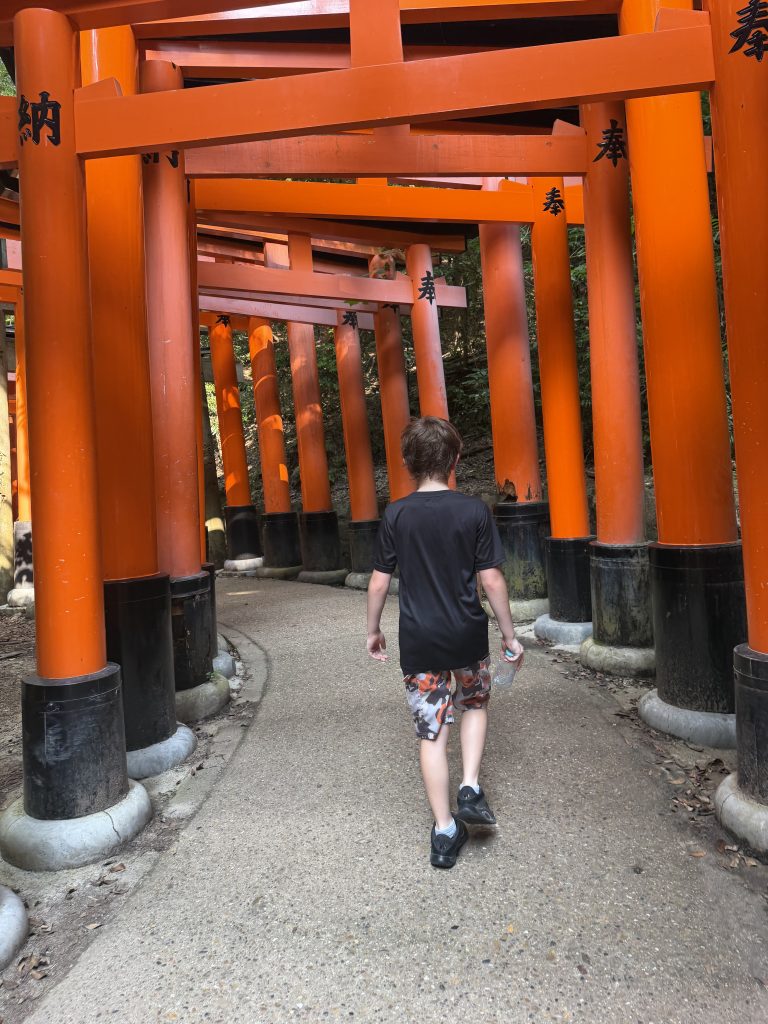
Our final day was filled with more beauty and history, as we explored the old neighborhoods of Kyoto, hoping to see a Maiko, or Geisha in training, in the Gion District. We hiked Fushimi Inari, another Shinto shrine famous for its red torii gates that cover the path almost the entirety of the 3 mile loop. This was surprisingly difficult, though majestic. We later learned that we’d hiked it on Japan’s hottest day of the year at that point, and a record breaker for summer heat at that! We took it easy that evening and walked along the canals lining the picturesque little streets in parts of Kyoto. Our hearts full, we boarded the plane for home the following day.
I think it’s hard to sum up the lesson learned traveling. It opens your heart and mind in a way that I don’t have a word for, which probably means I should find out if the Japanese do! The trip ended up being a beautiful arc from human brilliance, to human tenderness. So much of Tokyo showed us the ingenuity of humans and what they can build. Hiroshima showed us what humans can endure and choose: peace and humanity. And Osaka and Kyoto showed us what humans can cultivate with its natural beauty as a quieter kind of genius.
From riding the subway all over Tokyo I learned that the precision, punctuality, quiet, and cleanliness even in huge cities weren’t what I thought would feel like cold efficiency. They were human ingenuity as a form of care for the society at large, showing respect for people’s time and space.
Being ill when I wanted to go nonstop taught me that slowing down when needed is productive rather than lazy. It’s hard for someone who self identifies as an over achiever, but once again life gently nudged me towards the understanding that pushing through isn’t the only acceptable form of strength. Pausing so I can fully show up later is a skill, not a failure, that I need to embrace.
Immersion in my own hilarious incompetence did exactly what I was hoping for: reminded myself what it feels like to be the struggling learner. And I especially have empathy for our language learners!
Along the same lines, I learned that the willingness to experience so many new things, wide-eyed and unskilled as I was at it all, was what made the learning so much fun!
From the sweet Japanese corset tightening granny I learned to speak up, even when you’re trying to be deferential and polite! Some situations need you to make your boundaries known. Or things may just keep tightening. How am I still learning this?! It’s a fun metaphor for the classroom though.
From kintsugi my lesson was obvious to me. I appreciated the reminder that cracks and flaws are really strength and resilience telling your story.
From Hiroshima I learned the capacity of human forgiveness. I learned that a place can hold grief and life all at once. Here, peace was an active word and a deliberate choice. They fold peace cranes. They make wishes. They continue to honor and tell the stories. They don’t stop sharing. They didn’t just mourn, they chose a path forward.
From the sumo wrestlers we learned that competition doesn’t have to mean contempt. Their practice was a part of practicing their religion, and they made it clear that their skill meant nothing if they didn’t have the respect for each other. The bowing after the match was over was respect for someone whether their skill matched yours or not. Respect for giving it their all, just as you did.
At the Osaka aquarium, I was reminded that delight is not a distraction from learning; it’s a mode of learning. We can’t forget that AWE is legitimate pedagogy!
I learned the power of finding a word for a feeling I’ve had all along! I’ve felt Yūgen in the Colorado mountains, the Costa Rican Jungle, the Alhambra of Spain, Cinqueterra in Italy. It was powerful to learn the word for it. Giving students the words helps them hold on to more of the world. Vocabulary is illumination.
Honestly, the lessons were countless, and I could probably keep going. It’s the kind of learning that you’re able to enjoy when you’re experiencing the joyful, surreal, and vulnerable excitement of traveling somewhere you’d thought you’d never manage to see.
I came home with my head full of connections and curriculum ideas. Along with a different posture towards it. Because so much of what I teach connects to everyday life, I can relate almost every aspect of this trip to the concepts I teach. I’m determined to help my students feel the wide-eyed wonder I did.
I was so excited to read Seek the Sun with my class. It’s a wonderful story on its own that has been made unforgettable by my pictures and videos on my experience at the very temple in Asakusa. Though I’m teaching third grade this year and not reading this book, I know my students will remember the book from last year and still be able to compare and contrast our country with another.
I love doing classroom transformations – turning our room into a coffee shop, a campsite, a Hawaiian beach – where themed stations let us practice the skills we’ve been learning. For Japanese Culture Day, the goal is the same, but turned inward; here is where I can get them to feel my wide-eyed wonder and not just move through it! They’ll get to work with sumo wrestler weight classes, purchasing with Yen, and Mt. Fuji hike elevation as math stations; a Hiroshima reflection for our social emotional learning; Japanese folktales for fiction comprehension and my aquarium experience as informational text; earthquakes and floods for science.The decor and challenges are the doorway, but the real surprise is the sense that the world is bigger and more beautiful than they know. We’ll see who I can get to join me…and if I can convince anyone to let me help them plan their own culture day for a country they have fallen in love with!
The kintsugi workshop practically wrote an SEL lesson for me, and I’m just as excited to collaborate with our art teacher on this one! It builds on how I talk to students about mistakes and growth. Hiroshima taught me that peace is an active, deliberate choice. We’ll fold it into how we explore empathy, community, citizenship, and conflict in SEL lessons throughout the year.
As I move through science experiments and lessons, I can connect with examples of biodiversity of the ocean, animal adaptations, and the unique properties and needs of bamboo. There is much more, but this trip really was my ‘trip to the mailbox’, which is a lesson in and of itself. I haven’t forgotten the lessons I learned from Eleanor before leaving, and I’ll include her lessons on going to the mailbox, repaying kindness, doing your best with what you have, and lessons on bravery and determination as well. Every step of the way, students will see what they’re learning from me is real life and connected to something out there in this great big world.
Although they weren’t on the plan, this trip will reach my students every day. It will extend well beyond the classroom, in ways I planned as well as in ways I didn’t expect. They get a teacher who traveled, and that changes what feels possible. Japan is no longer a page in a text book. I can make it real with artifacts, stories, photos, and origami cranes welcoming them back with a wish for peace and kindness this year. They get a teacher who models lifelong learning. I can show them that adults are still changed by new experiences. I can tell them how I sat in their seat just this summer and felt what it’s like to not know the answer, to be grasping for the word. All of the lessons I shared above will be shared with them. I’ve always felt that students appreciate and learn better from a teacher that is authentic and grounded, transparent and serious about relationship building with students. These experiences, these lessons, that is how we pull that off, and that helps students learn all year with us, and often beyond that.
There’s more student impact in this trip deepening my understanding of my master in Culturally and Linguistically Diverse Education. I decided to be a learner far ahead of knowing if my trip would happen and took it upon myself to learn Japanese. I love learning languages, with Spanish being my strongest second language, and I’ve enjoyed building off of that base to learn more Romance languages, and German, too. None of this prepared me for Japanese. Two new and unfamiliar alphabets AND a system of kanji symbols separate from that for whole words, and a wildly different grammar structure made Japanese a great linguistic challenge. And once I was on the ground, what I’d felt learning Japanese so slowly beforehand was confirmed: I’d invested a lot of time and gotten…not very far. No one was impressed even by the fact that I’d tried. They just felt pity on me and usually switched to English! My experiences learning and using Japanese, both before and after the trip, have been eye opening. I feel I have a closer understanding of our newcomers who are suddenly immersed in English. I am guilty of launching into Spanish the second they falter, but being in the learner’s shoes made me reflect on that. I didn’t like that; how would my Japanese improve if everyone who could speak my native language defaulted to English for me?! This was a deeply challenging language experience, and the first language that I didn’t simply ‘take off’ in. It was humbling and pedagogy challenging all at once, and I’ve already changed the way I structure interactions with students who speak another language!
Luckily there are ways the trip impact goes beyond my classroom. Kintsugi will also be shared with our art teacher, sumo with PE, the bullet train and responsive coding from Team Labs with Digital Studio. I also plan to use sumo during movement time since we are a movement school with planned breaks for students and staff alike to get some energy out. I want to join my class on any lessons that relate to my trip. I’ll share natural disasters and volcanoes with our second graders and fourth graders, who also have natural disaster standards and texts they read. I’ll seek out opportunities to collaborate beyond our school too if possible, because the connections are endless – from curriculum to character to everyday tidbits I share with my class.
Standing at the end of it, I keep returning to one idea: I witnessed human brilliance, human tenderness, and human respect for the natural world. Travel cracks your whole frame of reference wide open, and I came home more sure than ever that wonder and joy aren’t distractions from learning – their the whole point of it. My students weren’t there, but they’ll inherit every mile I walked. Which was a lot, by the way. They’ll also inherit a teacher who keeps growing and loving life and learning, all so she can hand that passion to them.